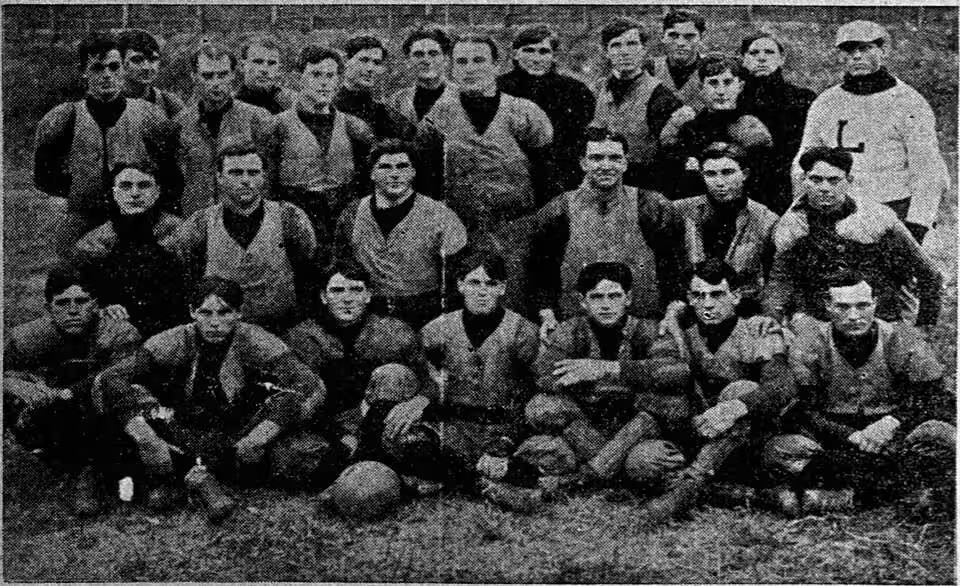
The University of Iowa had its first year on the gridiron, and it was a one-and-done season. Like many schools in the early 1890s, curious student groups wanted to dip their toes in the water and try this new football fad sweeping across campuses nationwide.
The early Iowa students put together an eleven to face Iowa College (now Grinnell College) in what would be their only matchup that season. The students had to organize it themselves and lean on some enrolled students from the East who had seen the game to teach the others, who were unfamiliar with how to play and what the rules and fundamentals were. Student leader Martin Sampson organized a squad and petitioned the faculty to recognize a varsity team. With Sampson serving as player-coach
After a few meetings and some intramural-style practices, the team felt confident enough to challenge Iowa College. The Grinnell group accepted, and on November 16, 1889, the teams met in Grinnell, Iowa, marking the first intercollegiate football game played west of the Mississippi River. The early Hawkeyes were not as prepared as they thought, as the more experienced Grinnell eleven blanked them 22-0. In what was supposed to be a home-and-home series, the Grinnellians did not travel to Iowa City on Thanksgiving Day. A bad Thanksgiving storm ended the inaugural season prematurely.
The University of Iowa would not register its first football win for another calendar year. November 27, 1890 (Thanksgiving Day), when the group defeated Iowa Wesleyan 91–0 in Mount Pleasant, Iowa.
The team played two earlier games in the second season: an October 18, 1890 loss to Iowa College (Grinnell) 14–6 in Iowa City, followed by the October 25, 1890 defeat at the hands of the S.U.I. Medics (University of Iowa Medical Department) 22–10 in an unscheduled campus grudge match.
Iowa played without a formal paid coach until 1892, when it hired E. A. Dalton. Early progress accelerated in 1896 under former University of Pennsylvania star Alfred E. Bull, who guided the team to a 7–1–1 record and its first conference title in the Western Interstate University Football Association. Bull’s offense revolved around halfback Frank “Kinney” Holbrook, the program’s first African American player and a former state champion sprinter. Holbrook led the team in scoring, famously breaking free for a 45-yard touchdown to secure Iowa’s first-ever conference win against Kansas.
Iowa joined the Western Conference (now the Big Ten) in 1899, and under coach Alden Knipe, claimed a share of the league title in 1900. Two decades later, head coach Howard Jones elevated the program to national prominence. Powered by legendary tackle Frederick “Duke” Slater—Iowa’s first Black first-team All-American—and star quarterback Aubrey Devine, Jones’s squads went undefeated in 1921 and 1922, capturing back-to-back Big Ten championships and retroactively earning national title recognition.
As for the “Hawkeyes” nickname, the university borrowed it directly from Iowa. In 1838, territorial governor Robert Lucas approved “Hawkeye” as a moniker for Iowa residents, a tribute inspired by the frontiersman hero Natty Bumppo in James Fenimore Cooper’s The Last of the Mohicans as well as Sauk leader Chief Black Hawk. While university teams used the name informally for decades, the visual identity solidified in 1948 when journalism instructor Richard Spencer III sketched a cartoon hawk that a statewide contest named Herky.
Here Are More Stories of Iowa Hawkeye Football Legends
- Gordon Locke: Iowa Hawkeyes Hall of Fame Legend
- Alex Karras: NFL Legend, Hall of Famer & Hollywood Star
- Nile Kinnick: Iowa Hawkeyes Legend and 1939 Heisman Winner
- Randy Duncan: The Hawkeye Field General Who Ruled the Big Ten
- Football History of February 18
- The Unstoppable “Cal” Jones: Iowa’s Outland Pioneer and Defensive Legend
- From Iowa to Immortality: Duke Slater, The Tackle Who Dominated Two Eras and Desegregated the NFL
- 🏈 Aubrey Devine: The Iowa Quarterback Who Ended Notre Dame’s 20-Game Streak


