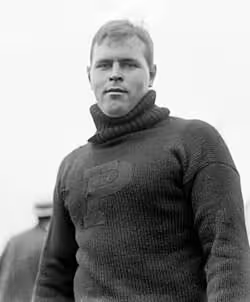
A legendary Penn State tackle turned tactical innovator, Dick Harlow reshaped early 20th-century football strategy with pioneering defensive slants, deceptive reverses, and iconic coaching stints at Penn State, Colgate, Western Maryland, and Harvard.
College Career
Richard Cresson Harlow was born on October 19, 1889, in Philadelphia, Pennsylvania. He attended Pennsylvania State University, starring as a standout tackle for the Nittany Lions during the 1910 and 1911 seasons under Bill and Jack Hollenback. A rugged and technically sound lineman, Harlow anchored the front for the undefeated 1911 squad that earned retroactive national title recognition. In addition to earning two varsity letters in football, Harlow demonstrated his multi-sport athleticism by competing for Penn State’s track and field and baseball teams.
Football Journey After College
Harlow did not play professional football; instead, he immediately transitioned into coaching and became one of the foremost tactical minds of the pre-World War II era. He served as an assistant at Penn State (1912–1914) before taking over as head coach from 1915 to 1917, posting a 20–8 record. After serving as a boxing coach and football assistant, Harlow became head coach at Colgate University (1922–1925), compiling a 24–9–3 mark.
He next took charge at Western Maryland College (now McDaniel College) from 1926 to 1934, establishing a dominant national powerhouse that went 60–13–7, including undefeated campaigns in 1929 (11–0), 1930 (9–0–1), and 1934 (8–0–1). In 1935, Harlow broke precedent by becoming the first non-alumnus ever hired as head football coach at Harvard University. He led the Crimson from 1935 to 1942, stepped away to serve as an officer in the United States Navy during World War II, and returned to guide Harvard from 1945 through 1947.
Football Legacy
Harlow’s lasting footprint is his revolutionary approach to schematics. Often facing physically larger squads, Harlow devised modern defensive stunts, looping linemen, and coordinated penetration to shoot gaps and bypass blockers rather than engaging head-on. Offensively, he perfected the “hidden-ball” concept, deploying lateral passes, deceptive spins, and intricate reverses that bewildered defenders. Beyond football, Harlow lived a renaissance life: he was a renowned oologist and professor of ornithology, collecting rare birds’ eggs and ferns while publishing academic research. He was elected to the College Football Hall of Fame in 1954.
The 1929 Western Maryland Green Terror football season stands as one of the most dominant campaigns in small-college gridiron history. Under fourth-year head coach Dick Harlow, the team finished 11–0, outscoring opponents 354 to 20 while recording eight shutouts.
Season Overview & Game-by-Game Results
Harlow scheduled a relentless 11-game slate that featured regional rivals, military academies, and major eastern programs.
| Date | Opponent | Location | Result | Score |
| Sept. 28 | Bridgewater | Westminster, MD | W | 68–0 |
| Oct. 5 | Baltimore | Westminster, MD | W | 47–0 |
| Oct. 12 | Gettysburg | Westminster, MD | W | 13–6 |
| Oct. 19 | Loyola (MD) | Westminster, MD | W | 46–0 |
| Oct. 26 | Temple | Philadelphia, PA | W | 23–0 |
| Nov. 2 | Washington College | Westminster, MD | W | 35–0 |
| Nov. 9 | VMI | Richmond, VA | W | 27–6 |
| Nov. 16 | Muhlenberg | Allentown, PA | W | 20–0 |
| Nov. 23 | Boston College | Boston, MA | W | 13–8 |
| Nov. 28 | Maryland | Baltimore, MD (Thanksgiving) | W | 13–0 |
| Dec. 7 | Western Reserve | Cleveland, OH | W | 49–0 |
Key Games of the Campaign
1. Temple (23–0)
Traveling to Philadelphia, Harlow faced a formidable Owls squad coached by Heinie Miller. Harlow’s defense completely smothered Temple’s single-wing attack, holding them to zero first downs in the second half while his misdirection backfield pulled away.
2. Boston College (13–8)
Played at Boston’s Alumni Field, this was Western Maryland’s stiffest test of the year. Trailing into the second half against a heavy, physical Eagles squad, Harlow opened up his playbook with a flurry of lateral sequences and delay plays. Two clutch fourth-quarter drives, capped by key yardage from halfback Bill Clark, delivered a signature road victory.
3. Maryland (13–0)
Contested on Thanksgiving Day at Baltimore Stadium in front of over 20,000 spectators, this in-state showdown decided regional supremacy. Curley Byrd’s Old Liners were favored by many metropolitan sportswriters, but Harlow’s shifting defensive front held Maryland to negative rushing yardage on early downs. Harlow utilized quick-kick punts to flip field position and capitalized on two short-field drives to seal the state championship.
Tactical Highlights
Harlow’s success in 1929 stemmed from tactical innovations that broke sharply from standard power-football dogmas of the era:
- Pioneering Defensive Slants and Stunts: Rather than matching the brute bulk of major university fronts, Harlow instructed his guards and tackles to play off the line of scrimmage, reading backfield flow and shooting angled interior gaps. This disruptive movement repeatedly blew up plays behind the line of scrimmage.
- The “Hidden-Ball” System: Harlow installed intricate spinner plays from the single-wing formation. Fullbacks and quarter-backs would feign handoffs, turn their backs entirely to the defense, and execute delayed handoffs or pitchouts. Opposing linebackers routinely tackled the wrong backs while the ball carrier slipped around the perimeter.
- Two-Platoon Foundations: While strict substitution rules governed the era, Harlow maintained exceptionally conditioned depth, rotating fresh line tandems without losing fundamental execution.
- Star Personnel: The 1929 team featured Western Maryland’s first bona fide national star, tackle Bill Havens, alongside versatile playmakers Bill Clark and quarterback Charley Havens (who later succeeded Harlow as head coach).
Harlow’s 1929 team out-schemed opponents through misdirection, precision timing, and relentless defensive penetration, cementing his reputation as one of the premier strategic builders in American football history.
Accolades, Awards, and Career Stats
- Overall Head Coaching Record: 149–69–17 (.670 winning percentage across 26 seasons)
- College Football Hall of Fame: Inducted in 1954 as a head coach
- AFCA National Coach of the Year: 1936
- Amos Alonzo Stagg Award: 1949 (awarded by the AFCA for outstanding service to football)
- Ivy League Coach of the Year: 1937
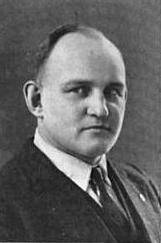
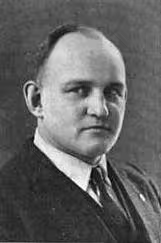
Pennsylvania State University – La Vie, p. 366
Here Are More Stories of Penn State Football Legends
- John Cappelletti: 1973 Heisman Winner & Penn State Icon
- Lighthorse Express: The Legendary Gridiron Run of Harry Wilson
- Pete Mauthe: Penn State’s Legendary Hall of Fame Fullback
- The Gridiron Greatness of Lydell Mitchell
- Mike Reid: Penn State’s Dominant Outland Trophy Virtuoso
- Glenn Ressler: Penn State’s Iron Interior Powerhouse
- Dave Robinson: The Ironman of the Nittany Lions and the “Lombardi” Packers
- Iron Mike Michalske: The Guard Who Revolutionized the Packers’ Line
- Ted Kwalick: The Blueprint for the Modern Tight End
- Riverboat Richie: The Dual-Threat Legend Who Outplayed the Bear
- Curt Warner: The Engine Behind Penn State’s First National Title
- Mike Munchak: The Blue-Collar Anchor of the Oilers’ Dynasty
- Shane Conlan: The Anchor of Penn State’s “Linebacker U”
- The First Legend of Linebacker U: The All-Purpose Brilliance of Dennis Onkotz
- Steve Suhey: Penn State All-American, WWII Veteran, and Hall of Famer
- From Nittany Lion Legend to NFL Pro Bowl QB: The Legacy of Kerry Collins
- ⚡ The Meteoric Midget: Gene “Shorty” Miller and the Fatal Kickoff
- The Catch in Happy Valley: The Day Penn State Stunned Nebraska
- Glenn Killinger Penn State Hall of Fame QB