Walter Eckersall, heralded as college football's inaugural superstar, epitomized the duality of athletic prowess and moral ambiguity in early 20th-century sports. This discourse delves into Eckersall's meteoric rise as a quarterback at the University of Chicago, where he achieved remarkable accolades yet was ultimately expelled under dubious circumstances that marred his legacy. We uncover how the very architects of college football conspired to safeguard their national championship while Eckersall, despite his celebrated status, engaged in ethically questionable practices that included fixing games. Accompanied by insights from historians Chris Serb and Timothy Brown, we navigate the complexities of Eckersall’s life, revealing the darker undercurrents that shaped his narrative and the sport itself. As we explore this multifaceted figure, we aim to present not merely a chronicle of triumph but a cautionary tale of the perils of idolization in athletics.
Special thanks to the experts from our archives who helped tell this story, along with our Amazon Associate link to their amazing books, which gets you the book and provides a slight commission to Pigskin Dispatch operating costs to help the consumer, author, and the Pig Pen! Win, Win, Win!
Chris Serb's book "Eckie: Walter Eckersall and the Rise of Chicago Sports" (2025)
Jennifer Taylor Hall (2021) is the author of a comprehensive biography on Coach Stagg, titled "Amos Alonzo Stagg: College Football's Man in Motion."
Timothy P. Brown of FootballArchaeology.com, who visits here every Tuesday, is the author of "How Football Became Football."
Don't forget to check out and subscribe to the Pigskin Dispatch YouTube channel for additional content and the regular Football History Minute Shorts.
Miss our football by the day of the year podcasts, well, don't, because they can still be found at the Pigskin Dispatch website.
Do you want more football history? Test your Gridiron Knowledge, we feed you Daily with our new FREE activity, The Pigskin Trivia Drive.
Grab a copy of our latest book, "Marooned," on the 1925 Pottsville Maroons NFL franchise saga.
*OR* Grab a copy of our book on Western Pennsylvania football history, "World's Greatest Gridiron Team" on the 1903 Franklin All-Stars
Drop us a line at PigskinDispatch@gmail .com and check out and subscribe to the Pigskin Dispatch YouTube channel.
Contact us directly at Pi*************@***il.com
Miss our football by the day of the year podcasts, well, don't because they can still be found at the Pigskin Dispatch website.
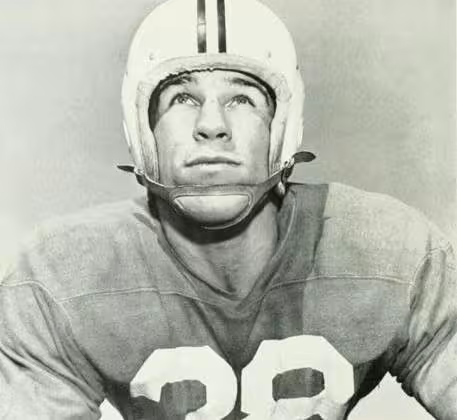
The illustrious journey of Walter Eckersall, regarded as the first iconic figure in American college football, is laden with both triumph and controversy. Emerging from the Chicago sports scene at the turn of the 20th century, Eckersall epitomized the prowess and potential of collegiate athletics. His remarkable high school tenure, marked by an impressive victory margin of 105-0 in a national championship game, ignited fervent interest from prominent coaches such as Fielding Yost of Michigan and Alonzo Stagg of the University of Chicago. Stagg's decisive intervention at a train station, where he persuaded Eckersall not to sign with rival Michigan, illustrates the fierce competition and strategic maneuverings prevalent in the early days of college football. Upon joining the University of Chicago, Eckersall's exceptional talent as a quarterback garnered accolades, leading his team to an undefeated season and a retroactively awarded national championship in 1905. However, beneath the surface of his athletic achievements lay a troubling reality of academic neglect and eventual expulsion for misconduct, which would shadow his legacy.
Transcript
Before college football became a billion dollar empire it is today, it was built on the back of America's first golden boy superstar.
Speaker A:A quarterback so unstoppable his coach physically intercepted him on a train podium before he got to a rival university to sign him.
Speaker A:To millions of roaring fans, Walter Eckers hall was the saintly face of a pure athletic glory.
Speaker A:But the moment the final down was played, the university stamped three chilling words onto his transcript, erasing him from the campus expelled for cause.
Speaker A:Now what did the founding fathers of college football cover up to protect their national championship?
Speaker A:And how did the sports most celebrated idol end up secretly calling penalties, cashing the promotional checks and writing the headlines for the very games he was fixing?
Speaker A:Walter Eckersol was a superstar coming out of high school.
Speaker A:At least that's how the press hyped him up.
Speaker A:We have some very good details from historians Chris Serb and Timothy Brown, who joined us on some earlier interviews over the last couple years on E's rise to fame.
Speaker B:So Walter Ersall was an athlete here in Chicago at the turn of the 20th century.
Speaker B:He was the first schoolboy superstar in Chicago sports history.
Speaker B:He was a, he was a three sports star.
Speaker B:He was a champion, a league champion, a state champion, even a national champion in three different sports.
Speaker B:He was, he was solid in football, he was solid in baseball, he was solid.
Speaker A:And track.
Speaker C:He was always like the kind of the smart kid, you know, the gym rat sort of person who, you know, understood the game, understood strategy, could be trusted to make the right call because they're the ones that called the signals at the line of scrimmage.
Speaker B:At the time he was, he was, he was the first high school athlete that got the big photos and the splashy headlines and stuff like that.
Speaker B:So he's a pioneer in that respect.
Speaker B:at the time it was founded in:Speaker B:The Big Ten itself was, was fairly new.
Speaker B:but it was, it was founded in:Speaker A:Eckersall was perhaps the first blue chip player of high school in the collegiate wars of joining football on the gridiron.
Speaker A:ainst Brooklyn Polytechnic in:Speaker A:Now this provoked famous teams at that time like Michigan's Fielding Yost to try to recruit him along with Alonzo Stagg, who Stagg allowed Hyde Park High school to practice at the Chicago University facilities and you know, even eat and do things with the team.
Speaker A:All because he liked Eckersol and knew what a phenom he was.
Speaker A:When he, when Stag found out that Eckersol was on his way, way to go meet Yost, he intercepted him at the Chicago train station platform and ended up talking him out of boarding that train to go to Ann Arbor.
Speaker A:You cannot leave yet.
Speaker B:Please listen to me.
Speaker B:It is not too late.
Speaker B:Stay and face it.
Speaker A:I will.
Speaker A:To visit Yost.
Speaker A:So Yoast couldn't recruit him.
Speaker B:Chicago to its greatest heights.
Speaker B:He, he was, he was an all Big Ten player for four years or an all big nine, I guess at the time.
Speaker B:All big nine player for four years as a quarterback.
Speaker B:Now three of those four years were before the forward pass.
Speaker B:So he was a running quarterback.
Speaker C:They ran with the ball mostly they blocked Eckersaw because he was so talented.
Speaker C:He was, you know, a runner as well.
Speaker B:But in that fourth year in his senior year, the forward pass was legal and he actually, he was a very good runner still, but he excelled at throwing the ball.
Speaker B:It was kind of this newfangled gadget, this newfangled gizmo.
Speaker B:And he was very good in very limited duty during that, during that senior year of his.
Speaker B:g year, the big, the big deal:Speaker A:Accolades for the Chicago Maroon star just kept coming in.
Speaker C:Now he was an all American in:Speaker C:But you know, even then I don't think he was a, you know, substantial passer.
Speaker C:You know, he back, you know, before the forward pass, the quarterback was mostly a blocking back, but he was, he was, you know, one of the top punters of his era, one of the top drop kickers of all time.
Speaker B:They won the national championship retroactively, I guess, the national championship in the Big Ten or the, or the big nine championship with a magnificent two to nothing victory over Michigan, which was, which broke their 56 game unbeaten streak.
Speaker B:That was the, that was the legendary point a minute teams with feeling Yost.
Speaker A:As the coach, Eckersall just wasn't able to function and pass the coursework that he was assigned at the University of Chicago.
Speaker A:So to protect their superstar Stag and William Rainey Harper, the school's president, would personally engineer the academic curriculum for him and put him under teachers that were football friendly.
Speaker A:lasses for entire Quarters in:Speaker A:Collier's Weekly blew the whistle.
Speaker A:Outing Ecker saw as merely an athletic ward, coddled by administrators, a direct violation of the Big Ten's found charter.
Speaker A:Now, these subpar academics were overlooked as Eckersol produced on the field.
Speaker A:But after his play was over, quite a different story occurred.
Speaker B:His senior season ended maybe six weeks after senior, senior season ended.
Speaker B:He was very quietly expelled from University of Chicago.
Speaker B:And on what the.
Speaker B:What the official documents say were loose morals, and they don't say much more about that.
Speaker B:But he had been.
Speaker B:He had been caught committing a theft.
Speaker B:He had been caught stealing, arrested, he made restitution.
Speaker A:e that he was eligible for in:Speaker A:In November, the school's tolerance for his exploits off the field had vanished.
Speaker A:The University of Chicago severed all institutional ties, bearing letters from alumni who described their former idol as a grafter as well as a monumental liar involved in theft, unpaid debts, and scandalous private conduct.
Speaker A:Stagg, whose entire Persona was built around the muscular Christian morality quote unquote, quietly distanced himself from the greatest star to protect the university's reputation.
Speaker A:Chicago University may have cut Ecke off, but coach Stagg in secret and his fellow Maroona lubs had not.
Speaker A:Stagg biographer Jennifer Taylor hall explains.
Speaker D:So In March of:Speaker D:And he, he, Bezdick had just taken the reins at Arkansas a few years earlier, and he was struggling against other teams that had already adopted the forward pass.
Speaker D:I mean, imagine losing to St. Louis University.
Speaker D:That's what happened, because back then, the Billikens were a solid football team, but they used the forward pass.
Speaker D:And so Bestick recognized that it was an innovation he needed to adopt.
Speaker D:But it wasn't as easy as simply doing it.
Speaker D:He needed to be taught, and his players needed to be taught.
Speaker D:And so who did he call?
Speaker D:He called his mentor, the man who had helped pioneer it.
Speaker D:And so Mr. Stagg traveled down to Fayetteville, brought Walter Eckersall, one of his former stars and obviously a friend of Bestic's, to Fayetteville, and the two of them set up a clinic.
Speaker A:Cut loose by academia, Eckersol took advantage of the heir's complete lack of journalistic and sporting ethics.
Speaker A:During the:Speaker A:In several high stakes games, including Marquee matchups involving Newt Rockne's Notre Dame squads.
Speaker A:Eckersol reportedly engaged in a free flagrant practice of triple dipping.
Speaker A:He blew the whistle as the head game official, collected checks as a promotional liaison and then retreated to the press box to write syndicated game recaps evaluating the very teams he had just officiated.
Speaker A:Very difficult thing to do, actually.
Speaker A:Not even sure that you could officiate and know what was going on in the game.
Speaker A:I've been there, been the stripe on the field and just noticing the level, trying to keep the level playing field, watching the play by play and the activities of the players to make sure they stay within the rules and safety is difficult enough knowing who scored a touchdown, how many yards and how many rushes they had.
Speaker A:Don't know how you could possibly do that in there and be an effective referee on the field.
Speaker A:il decades after his death in:Speaker A:Now we want to thank our guests that contributed today, Timothy P. Brown and Jennifer Taylor hall, both authors in their own right.
Speaker A:You can find some of their works and footballarchaeology.com of Tim Brown's in the show.
Speaker A:Notes here, links to that.
Speaker A:terviewed back in November of:Speaker A:You can find more and learn more about Eckersol in that book.
Speaker A:search of Robin lester in the:Speaker A:And we want to thank you for enjoying joining us here today for the life of Walter Eckersall and even some of the dark sides of that life.
Speaker A:And a great football legend.
Speaker A:And is this in no way it was meant to taint his legendary performance on the field?
Speaker A:He was a great player and one of the best players probably to ever take the field in the game.
Speaker A:That's all the football history we have today, folks.
Speaker A:Join us back tomorrow for more of your football history.
Speaker A:We invite you to check out our website pigskindispatch.com not only to see the daily football history, but to experience positive football with our many articles on the good people of the game as well as our own football comic strip cleat marks comics pigskindispatch.com is also on screen social media outlets, Facebook, Twitter, Instagram and don't forget the Big Skin Dispatch YouTube channel to get all of your positive football news and history.
Speaker A:Special thanks to the talents of Mike and Gene Monroe, as well as Jason Neff for letting us use their music during our podcast.
Speaker A:This podcast is part of the Sports History Network, your headquarters for the yesterday of your favorite sport.
Speaker A:You can learn more@sportshistorynetwork.com.