The clandestine meeting between NFL and AFL executives in a Dallas parking lot marked a pivotal moment in the history of professional football, as it laid the groundwork for the eventual merger of these two rival leagues. This episode delves into the intricacies of this secretive encounter, highlighting the intense competition that had characterized the relationship between the leagues for six years. What began as a struggle for dominance transformed into a strategic alliance, culminating in a groundbreaking agreement that would forever alter the landscape of American football. We explore the motivations behind this merger, the financial implications, and the lasting impact it has had on the sport, ultimately leading to the creation of the Super Bowl as we know it today. Join us as we recount this remarkable chapter in football history, illustrating how a simple meeting between two adversaries heralded a new era in the game.
The narrative unfolds with an intriguing examination of a pivotal moment in sports history, specifically the clandestine negotiations that transpired in Dallas between two prominent figures from rival football leagues. This historical recounting emphasizes the competitive animosity that characterized the relationship between the National Football League (NFL) and the American Football League (AFL) during the mid-1960s. Initially perceived as a lesser league, the AFL’s resilience and strategic maneuvers shifted the dynamics, escalating tensions into what could be described as a financial warfare over player acquisitions. The episode meticulously chronicles the escalation of bidding wars for college football stars, culminating in the groundbreaking signing of quarterback Joe Namath, whose contract shattered previous financial records and signaled the AFL’s determination to rival its established counterpart. As the two leagues grappled with their financial duress, a secret meeting was orchestrated, bringing together Tech Sram of the NFL and Lamar Hunt of the AFL. Their negotiation, conducted discreetly in a parking lot, was aimed at crafting a merger that would forever alter the landscape of professional football. The agreements reached during this clandestine gathering included the establishment of a common draft and the creation of a shared championship game, which would eventually evolve into what is now known as the Super Bowl. This summary encapsulates the essence of the episode, illustrating the profound transformations initiated by a strategic alliance born out of necessity, rivalry, and visionary leadership. The episode culminates in a reflection on the monumental implications of this merger, highlighting the inaugural Super Bowl matchup between the Green Bay Packers and the Kansas City Chiefs. This concluding segment serves as a poignant reminder of how a series of calculated decisions and negotiations not only resolved a fierce rivalry but also laid the foundation for what has become one of the most significant events in American sports culture. The narrative encapsulates the essence of competition, collaboration, and the relentless pursuit of excellence that defines the sport today.
We would like to thank SportsLogos.Net for allowing us to use a couple of their logos.
Do you want more football history? Grab a copy of our Award-Winning book, “The World’s Greatest Pro Gridiron Team: The 1903 Franklin All-Stars” at https://amzn.to/4rG6uVe
Don’t forget to check out and subscribe to the Pigskin Dispatch YouTube channel for additional content and the regular Football History Minute Shorts.
Miss our football by the day of the year podcasts, well, don’t, because they can still be found at the Pigskin Dispatch website.
Come join us at the Pigskin Dispatch website and the Sports Jersey Dispatch to see even more Positive football news! Sign up to get daily football history headlines in your email inbox @ Email-subscriber
Transcript
Before there was a Super bowl, there was a secret meeting in Dallas with two owners of the teams on each side that met in a car, sat there and mapped out a strategy to plan out what the future of the National Football League would be.
Speaker A:as we flash back into the mid-:Speaker A:Our story starts with not a game, but with an insult.
Speaker A:For six years, the National Football League called the American Football League a lot of things.
Speaker A:A minor league, a Mickey Mouse operation, a nuisance that would fold into the moment.
Speaker A:Real football fans would look away.
Speaker A:But the nuisance did not fold.
Speaker A:It grew.
Speaker A:Assigned players.
Speaker A:The NFL had ignored it at landed television deals that the NFL couldn't ignore.
Speaker A:And by the middle of the:Speaker A:They were at war.
Speaker A:And wars are expensive now.
Speaker A:The war had been fought with checkbooks.
Speaker A:Every college star became a battlefield.
Speaker A:Both leagues bid against each other for the same 22 year old kids.
Speaker A:And the price just kept escalating up and up.
Speaker A:In:Speaker A:The number that hit the papers was $427,000.
Speaker A:The richest contract in the history of professional football.
Speaker A:And a message is sent with suit simple.
Speaker A:The AFL would not be outbid for the top players in the nation.
Speaker A:For the NFL it was a crisis dressed as a game.
Speaker A:They had the history, they had the prestige of the championships.
Speaker A:But the history doesn't pay the bills.
Speaker A:Every dollar the AFL spent was a dollar the NFL had to match.
Speaker A:And both leagues were bleeding.
Speaker A:And the men who ran them knew it couldn't go on for long.
Speaker A:Now here's the part that sounds like a movie because basically it was.
Speaker A:In the spring of:Speaker A:One side, Tech Sram, the general manager of the Dallas Cowboys, the NFL's guy.
Speaker A:On the other side was Lamar Hunt, the owner of the Kansas City Chiefs, the man who had founded the AFL in the first place and moved his team out of the Dallas area just a few years before so his team could be have their own identity in Kansas City.
Speaker A:Now they met in cars in a parking lot, far away from owners, away from the press, away from anyone who could blow it up before it got started.
Speaker A:Two men on opposite sides of a six year war sketching a peace treaty on scratch paper.
Speaker A:And the piece they drew had a name neither league could say out loud yet.
Speaker A:A merger.
Speaker A:,:Speaker A:And here's what they actually agreed to.
Speaker A:h a common draft beginning in:Speaker A:They would stop competing for championships.
Speaker A:itle game starting in January:Speaker A:A game that didn't even have a name yet and what we now call the super bowl.
Speaker A:And by:Speaker A:All 10 AFL franchises would be folded into a single organization.
Speaker A:One name, one commissioner, Pete Roselle.
Speaker A:And the NFL wasn't absorbing the rival.
Speaker A:It was merging with one.
Speaker A:But there was a price.
Speaker A:The AFL paid the older league 18 and a half million dollars in an indemnity.
Speaker A:Call it a tribute, a buy in.
Speaker A:No way that they could get in without it.
Speaker A:But either way, the money was the quiet part, the part that told you that really was conceding to what.
Speaker A:Now, this was the part that nobody remembers.
Speaker A:It's the part that tells you that the merger really cost.
Speaker A:Roselle wanted one thing above all.
Speaker A:A championship game between the two equal conferences.
Speaker A:But there was a math problem.
Speaker A:10 AFL teams, 16 NFL teams.
Speaker A:To make two equal sides, three NFL teams would have to leave their league.
Speaker A:Enjoy the AFL side.
Speaker A:Now, think about what that meant.
Speaker A:The Baltimore Colts, the Cleveland Browns, the Pittsburgh Steelers.
Speaker A:Three of the oldest, proudest franchises in the game.
Speaker A:Asked to walk away from the league, they spent six years mocking.
Speaker A:One official who was there put it plainly.
Speaker A:It was like being asked to move into the lesser league.
Speaker A:That was not.
Speaker A:That's how they saw it.
Speaker A:But the meetings turned bitter.
Speaker A:For a while, it looked like the whole thing would just collapse over pride.
Speaker A:Then one man stood up, Art Modell, the owner of the Browns.
Speaker A:And he told the room that he would move his franchise to the new conference on two conditions.
Speaker A:That Wellington Mara, owner of the Giants, give him his blessings and the Art Rooney, owner of the Steelers, would come with him.
Speaker A:Rooney came, the Colts followed.
Speaker A:And the conference service was balanced.
Speaker A:In the rivalries those moves created, they're some of the best in football today.
Speaker A:Now, there's one last gate.
Speaker A:Merging the two leagues was, on paper, illegal, a violation of federal antitrust law.
Speaker A:So the deal needed permission from the United States Congress of all parties.
Speaker A:Now, permission came with a price tag of its own.
Speaker A:To get the votes, the league promised new teams, expansion franchises for politicians who wanted football in their cities.
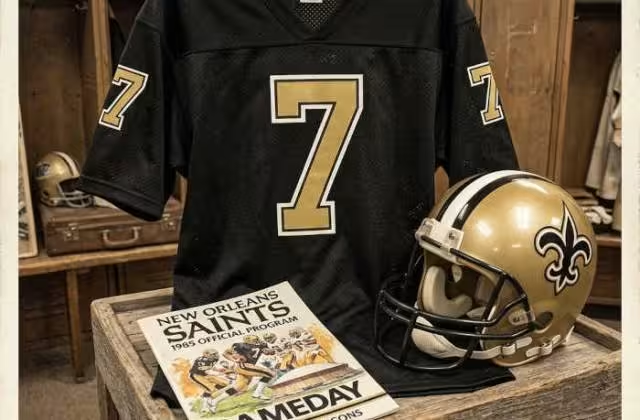
Speaker A:The most famous of them, the New Orleans Saints, born as a bargaining chip.
Speaker A:Before it ever took a snap.
Speaker A:passed the exemption in late:Speaker A:And the deal was done.
Speaker A:,:Speaker A:A game with no trophy name, no roman numerals, and no idea what was going to become of the biggest single event in American sports.
Speaker A:But The packers won 35 to 10.
Speaker A:But the real winner that day was the merger itself.
Speaker A:The two leagues have gone from a war to a shared championship in under a year.
Speaker A:Every super bowl you've watched, the roman numerals, the halftime show, two conferences colliding in February.
Speaker A:,:Speaker A:The NFL didn't beat the AFL that year.
Speaker A:They bought it.
Speaker A:They merged with it.
Speaker A:They called the whole thing one League.
Speaker A:And the game you're watching today is the one they designed in that parking lot.
Speaker A:Thanks for joining us.
Speaker A:e you can find any event from:Speaker A:We're here for you and we're telling the story like it is, with facts and and we'd love to have your input.
Speaker A:Pigskind dispatch Gmail.com is a way to get in touch with us.
Speaker A:Until next time, everybody.
Speaker A:Have a great gridiron day.
Speaker B:Think you know your football history?
Speaker B:It's time to put your pads on with the pigskin trivia drive.
Speaker B:Choose your play.
Speaker B:Go for a run short pass or.
Speaker A:Risk it all with a long pass.
Speaker B:Answer fast to rack up the yardage and reach the yellow line for a first down and earn audible to wipe.
Speaker A:Away those wrong answers.
Speaker B:But watch out.
Speaker B:That play clock has gotcha.
Speaker B:We got 25 seconds before the penalty hits.
Speaker B:Score as many touchdowns as you can in five minutes and claim your spot.
Speaker A:On a global leaderboard.
Speaker B:Pigs can drivia drive where your football IQ is the MVP play now@pixkindispatch.com.